
Wood, Humidity and the Pursuit of Stability
Why a wooden bass guitar will always move and why good instrument making is about understanding and controlling
that movement, rather than pretending it doesn’t exist.
Wood
Wood is a remarkable material for musical instruments. It is relatively light, strong, resonant and, perhaps most importantly, familiar. Much of the music that shaped our idea of what an electric bass should sound and feel like was made on wooden instruments.
But wood is not perfect. Nor is it static. Wood is a hygroscopic material, meaning that it exchanges moisture with the surrounding air. As relative humidity rises, wood absorbs moisture and expands. When the air becomes drier, it releases moisture and contracts. These changes are small, but in an instrument built to tolerances measured in fractions of a millimetre, small changes matter.
A neck may develop slightly more or less relief. Fret ends can become more noticeable in very dry conditions. Action can change. A body and neck can move by different amounts and in different directions, depending on the species of wood, how it was cut and the orientation of the grain.
Yoshi Kikuchi has spent around four decades building instruments in Japan, a country where wood is exposed to considerable seasonal changes in temperature and humidity. Japanese summers can be hot and very humid, while winters are considerably drier, particularly indoors where heating is used. Instruments made in Japan may subsequently travel to Europe, North America or other parts of the world, encountering entirely different climates along the way.
Even within Europe, an instrument can experience large changes. A dry, heated or air-conditioned room can create relative humidity around 20–30%, while humid summer conditions can reach 70–80% or more.
For a wooden musical instrument, that is a substantial environmental range. The goal, therefore, cannot realistically be to create a wooden bass that never moves at all. The goal is to build one that moves as little and as predictably as possible.
Long-term stability begins before a neck is shaped. The choice and preparation of the wood matter enormously. Wood needs to be properly seasoned and sufficiently stable before it becomes part of an instrument. Grain orientation, density and the individual characteristics of a particular piece all play a role. This is also where experience remains important.
Wood is not an industrial material with perfectly identical properties from one piece to the next. Two pieces of maple from the same species, even from the same tree, are not necessarily mechanically identical.
At Kikuchi, careful material selection is therefore an important part of the building process. Yoshi is not simply looking for wood that looks good. He is looking for material that he believes will remain stable and behave appropriately as part of a musical instrument.
Adding stiffness without abandoning wood
Every Kikuchi neck is reinforced with graphite rods alongside the adjustable truss rod. The two perform different functions.
The truss rod allows the neck relief to be adjusted to suit the strings, setup and player’s preference. The graphite reinforcement adds stiffness to the neck structure itself and helps make it less susceptible to unwanted movement.
There is an interesting balance here. In purely engineering terms, it would be possible to move much further away from wood. Carbon fibre, aluminium and other engineered materials can offer greater consistency and rigidity. Bass makers have explored these possibilities very successfully for decades. But absolute rigidity is not the only objective at Kikuchi.
The intention is to retain the response and familiar character of a traditional wooden instrument while improving its stability and consistency. In other words: refinement rather than replacement. The neck and body as one system
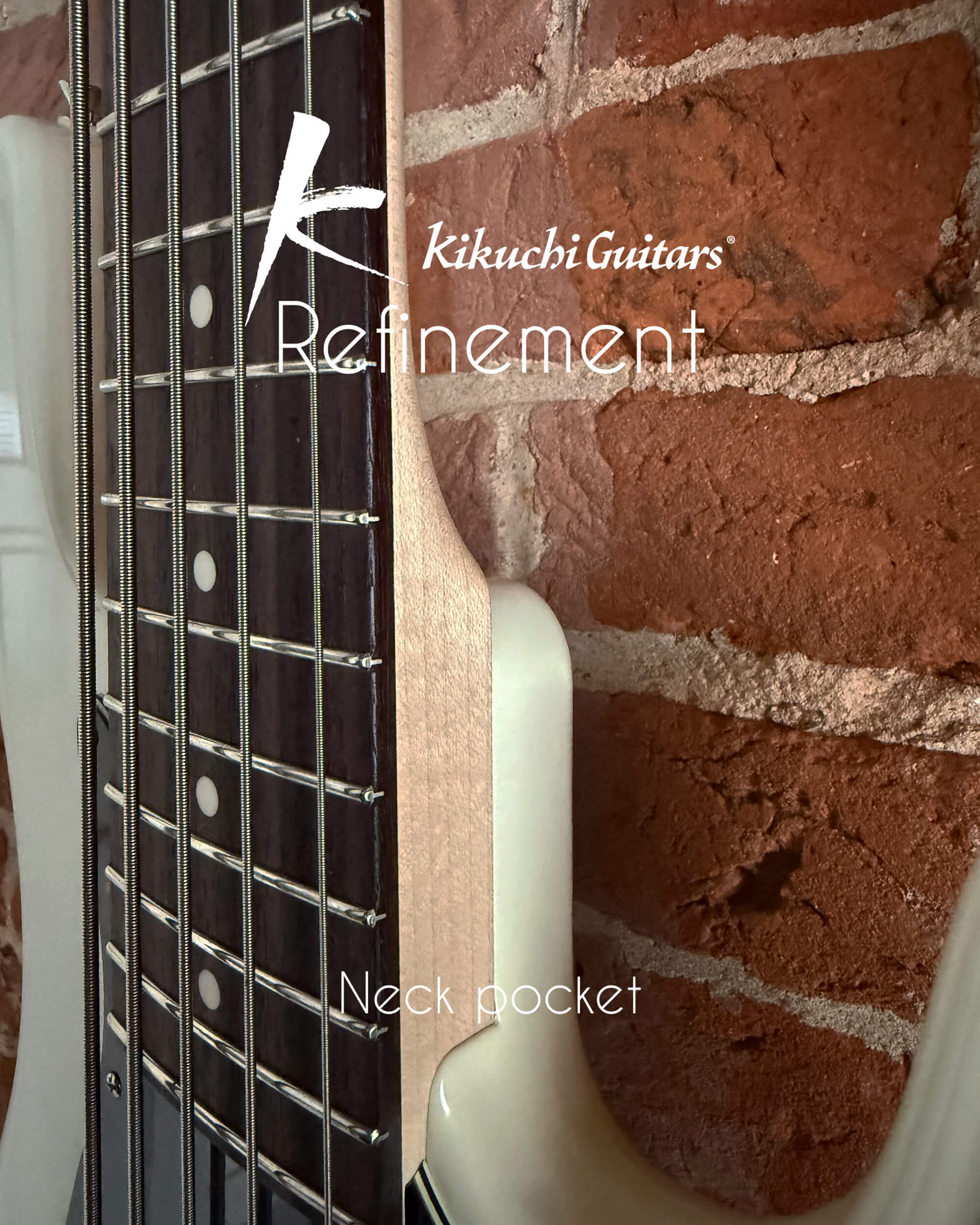
Tight pocket
Another detail Yoshi pays particular attention to is the connection between neck and body.
Kikuchi basses use a carefully fitted neck pocket with very little unnecessary space between the two components. From a construction perspective, this creates a secure and repeatable mechanical connection between neck and body.
It is tempting to make sweeping claims about what a tight neck pocket does to “tone” or sustain. In reality, an electric bass is a complex mechanical system. Neck stiffness, body mass, wood properties, bridge construction, strings, pickups and many other factors interact with one another.
What we can say is that Kikuchi’s approach is to make the neck and body work together as consistently as possible, rather than treating them as two loosely connected components. That philosophy extends throughout the instrument.
Stability and resonance are not opposites
This is perhaps the more interesting question. If maximum dimensional stability were the only objective, why build a bass from wood at all? Because an instrument is not a laboratory measuring device.
The objective is not simply to eliminate vibration. A bass needs to vibrate, but preferably in ways that contribute to a predictable and musically useful response.
Every physical structure has resonances. In a bass guitar, some combinations of neck, body, hardware and strings can reinforce certain frequencies while reducing others. In more pronounced cases this can contribute to what players commonly describe as dead spots or wolf tones.
Increasing neck stiffness can help shift structural resonances and reduce the severity of some of these effects. But simply making every component as rigid or as heavy as possible is not necessarily the answer if the aim is still to create an instrument that feels and responds like a great traditional wooden bass.
For Kikuchi, the challenge is therefore not stability versus resonance. It is finding the right relationship between the two.
Evolution, not revolution
Wood varies. Wood reacts to its environment. No two pieces are exactly alike. Glue joints, grain structures and material properties introduce variables that an engineer designing a precision measuring instrument might prefer to eliminate entirely. And yet musicians have been making extraordinary music on wooden instruments for centuries. Rather than seeing this as a reason to abandon wood, Kikuchi approaches it as a reason to understand it better.
Select it carefully. Season it properly. Reinforce it where useful. Machine and handfinish it accurately. Create precise connections between components. And apply decades of experience to the small decisions that cannot always be reduced to a specification sheet. The result is still unmistakably a wooden bass guitar.
Just one in which many of the traditional variables have been carefully considered and controlled. That is very much the Kikuchi philosophy: not trying to reinvent the electric bass, but continuing to refine what already works.
Because true refinement isn’t measured only on the workbench. It is measured after years of playing.
One Comment
Leave A Comment
Obvioudsly there is more than meets the eye.. and ear! ;-)