
What Makes a Great B String?
It’s one of the most frequently asked questions about a five-string bass: “How good is the B string?”
It’s a perfectly reasonable question. A low B has a difficult job to do. Its fundamental frequency is around 31 Hz, the string is relatively thick, and we still expect it to respond quickly, produce a clearly defined note and feel connected to the other four strings.
But perhaps we should start with another question…
What exactly is a good B string?
Tight isn’t necessarily better. Words like tight, powerful and massive are often used to describe a good low B. Those can certainly be desirable qualities. But a B string isn’t supposed to win a competition against the other strings.
If the B is dramatically louder, darker or more powerful than the E string, that’s not necessarily a sign of a great five-string bass. Ideally, moving from one string to another should feel natural. The goal is not an impressive B string in isolation.
The goal is an even, musical response across all five strings and across the fingerboard. It’s a system, not a single specification Just as with instrument weight, there isn’t one specification that determines the result.
Scale length is an obvious example. A longer scale can increase tension and change the way a low B feels and responds. This is one reason why 35-inch and longer scale lengths have become popular on five-string basses. But scale length alone doesn’t create a great B string. A well-designed 34-inch bass can have an excellent low B, while a longer-scale instrument doesn’t automatically guarantee one.
The entire instrument is involved.
Neck construction and stiffness, the neck-to-body connection, the dimensions and properties of the wood, bridge and hardware, fretwork, pickups and electronics all contribute to how the energy of a vibrating string is translated into something we experience as a note. And, as always, these elements don’t operate independently.
Design meets experience
This is where experience becomes important. Yoshi Kikuchi has been building instruments for around four decades. Over that time, he has worked on countless basses and experimented with construction, materials and dimensions — not simply to achieve certain numbers on a specification sheet, but to understand how those choices interact in a finished instrument.
The five-string Kikuchi basses retain a 34-inch scale by design. The aim isn’t to create the tightest B string possible at any cost, but to combine a convincing low B with the familiar feel and response of the instrument as a whole. It’s another example of designing the complete system rather than optimising one isolated parameter.
Don’t forget the setup
Even a beautifully constructed bass still needs to be adjusted for the person playing it. String height, neck relief, nut height, intonation and pickup height all affect response and playing feel. And there is no single perfect setup.
A player with a very light touch may prefer an extremely low action. Someone who plays more aggressively may need more room for the strings to move. The same bass can therefore feel and respond quite differently in different hands — or with a different setup.
A good setup isn’t simply about making the strings as low as possible. It’s about making the instrument work for the player.
And then there are the strings… and more things…
We haven’t even discussed the actual strings yet. Gauge, construction, core shape, materials, tension, flexibility and age can all influence the behaviour of a low B. Put a different set of strings on the same bass and the result can be surprisingly different.
And after that comes the signal chain. Pickups, preamp, pedals, amplifier, cabinet and even the acoustics of the room all influence what ultimately reaches your ears. A cabinet that struggles to reproduce the lowest frequencies can tell a very different story about the same bass than a well-controlled amplification system.
So asking whether a bass has “a good B string” sounds like a simple question. The answer isn’t.
Listen to the whole instrument
When trying a five-string bass, don’t just hit the open B and listen for maximum impact. Instead, play lines that move naturally across the B, E and A strings, and try the same phrases in different positions across the fingerboard. Listen to the attack, sustain and character of the notes — but also to how naturally they connect. Feel how the instrument responds under your fingers.
And then, perhaps, stop analysing altogether. When a five-string bass really works for you, you shouldn’t have to think about which string you’re playing. The low B should feel and sound like a natural extension of the instrument — not louder, bigger or more impressive simply because it goes lower.
A great B string doesn’t need to demand attention. It simply belongs.
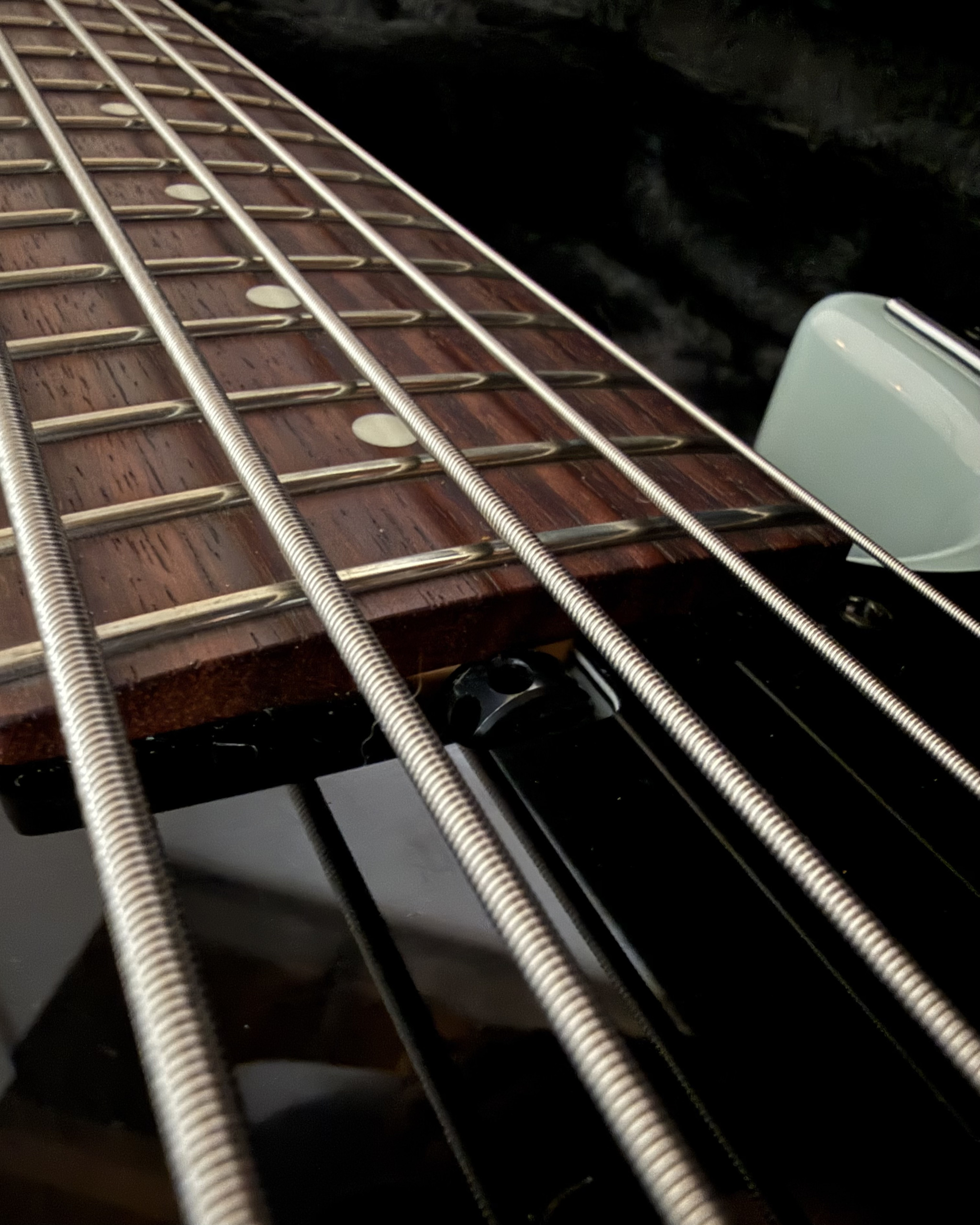
What Makes a Great B String?
It’s one of the most frequently asked questions about a five-string bass: “How good is the B string?”
It’s a perfectly reasonable question. A low B has a difficult job to do. Its fundamental frequency is around 31 Hz, the string is relatively thick, and we still expect it to respond quickly, produce a clearly defined note and feel connected to the other four strings.
But perhaps we should start with another question…
What exactly is a good B string?
Tight isn’t necessarily better. Words like tight, powerful and massive are often used to describe a good low B. Those can certainly be desirable qualities. But a B string isn’t supposed to win a competition against the other strings.
If the B is dramatically louder, darker or more powerful than the E string, that’s not necessarily a sign of a great five-string bass. Ideally, moving from one string to another should feel natural. The goal is not an impressive B string in isolation.
The goal is an even, musical response across all five strings and across the fingerboard. It’s a system, not a single specification Just as with instrument weight, there isn’t one specification that determines the result.
Scale length is an obvious example. A longer scale can increase tension and change the way a low B feels and responds. This is one reason why 35-inch and longer scale lengths have become popular on five-string basses. But scale length alone doesn’t create a great B string. A well-designed 34-inch bass can have an excellent low B, while a longer-scale instrument doesn’t automatically guarantee one.
The entire instrument is involved.
Neck construction and stiffness, the neck-to-body connection, the dimensions and properties of the wood, bridge and hardware, fretwork, pickups and electronics all contribute to how the energy of a vibrating string is translated into something we experience as a note. And, as always, these elements don’t operate independently.
Design meets experience
This is where experience becomes important. Yoshi Kikuchi has been building instruments for around four decades. Over that time, he has worked on countless basses and experimented with construction, materials and dimensions — not simply to achieve certain numbers on a specification sheet, but to understand how those choices interact in a finished instrument.
The five-string Kikuchi basses retain a 34-inch scale by design. The aim isn’t to create the tightest B string possible at any cost, but to combine a convincing low B with the familiar feel and response of the instrument as a whole. It’s another example of designing the complete system rather than optimising one isolated parameter.
Don’t forget the setup
Even a beautifully constructed bass still needs to be adjusted for the person playing it. String height, neck relief, nut height, intonation and pickup height all affect response and playing feel. And there is no single perfect setup.
A player with a very light touch may prefer an extremely low action. Someone who plays more aggressively may need more room for the strings to move. The same bass can therefore feel and respond quite differently in different hands — or with a different setup.
A good setup isn’t simply about making the strings as low as possible. It’s about making the instrument work for the player.
And then there are the strings… and more things…
We haven’t even discussed the actual strings yet. Gauge, construction, core shape, materials, tension, flexibility and age can all influence the behaviour of a low B. Put a different set of strings on the same bass and the result can be surprisingly different.
And after that comes the signal chain. Pickups, preamp, pedals, amplifier, cabinet and even the acoustics of the room all influence what ultimately reaches your ears. A cabinet that struggles to reproduce the lowest frequencies can tell a very different story about the same bass than a well-controlled amplification system.
So asking whether a bass has “a good B string” sounds like a simple question. The answer isn’t.
Listen to the whole instrument
When trying a five-string bass, don’t just hit the open B and listen for maximum impact. Instead, play lines that move naturally across the B, E and A strings, and try the same phrases in different positions across the fingerboard. Listen to the attack, sustain and character of the notes — but also to how naturally they connect. Feel how the instrument responds under your fingers.
And then, perhaps, stop analysing altogether. When a five-string bass really works for you, you shouldn’t have to think about which string you’re playing. The low B should feel and sound like a natural extension of the instrument — not louder, bigger or more impressive simply because it goes lower.
A great B string doesn’t need to demand attention. It simply belongs.