
Bass Weight vs. Balance: What Really Matters?
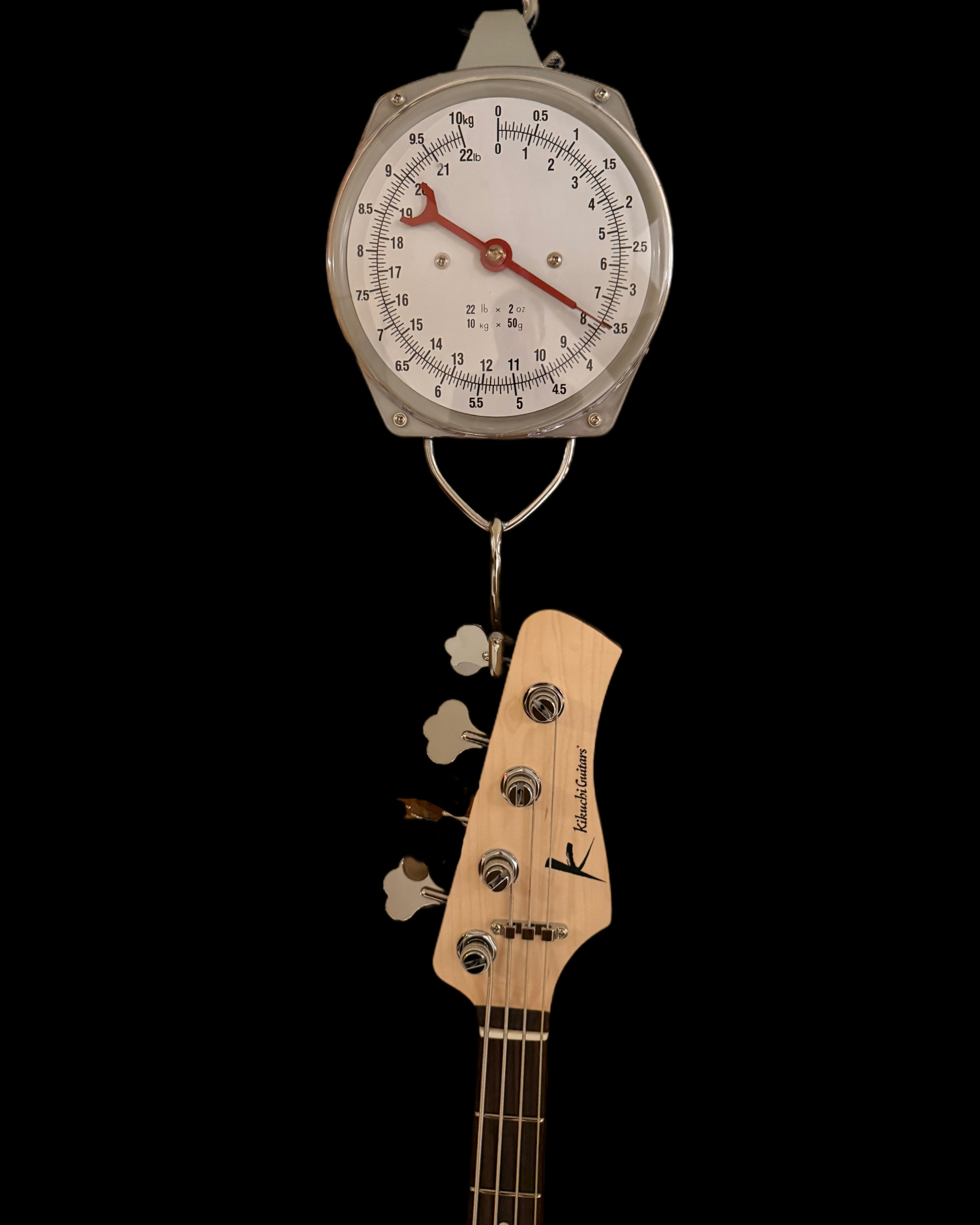
Ask bass players about comfort and one number often comes up first: weight. Is it under four kilos? Is this five-string particularly light? Will it still feel comfortable after a three-hour gig? Weight certainly matters. But the number on the scale tells only part of the story.
A light bass isn’t automatically a comfortable bass. Two basses of exactly the same weight can feel surprisingly different on a strap. The reason is balance. Where the weight is located matters. A bass that naturally stays in playing position requires less effort from the player than one that constantly wants to tilt forward or pull the neck towards the floor.
Body shape, body mass, neck weight, headstock design and strap-button position all contribute to this. Even the way an instrument sits against the player’s body can make a difference. This is why simply chasing the lowest possible weight isn’t necessarily the same as designing the most comfortable instrument.
And then there’s the player
There is another part of the equation that is easily overlooked: playing condition. We discussed this with Amsterdam-based Human Movement Scientist and Strength & Conditioning Coach Tom Bruijnen. His perspective adds an interesting nuance to the weight discussion.
Within normal ranges, the difference between a slightly lighter and heavier bass may have less impact on the player than we sometimes assume. What can matter considerably more is what your body is accustomed to doing.
If you always practise sitting down, for example, suddenly playing a three-hour show standing up can be demanding — regardless of whether your bass weighs 3.7 or 4.2 kg. Playing an instrument is a physical activity. Like other physical activities, your body adapts to what you regularly ask it to do. If you want to be comfortable playing long shows standing up, it therefore makes sense to include standing up in your practice routine and gradually build the capacity required for it.
Weight is one piece of the puzzle
None of this means that instrument weight is irrelevant. All other things being equal, carrying less weight is obviously attractive. And individual players can have very different preferences and physical requirements. But weight is only one piece of a much larger puzzle.
A lighter instrument will not necessarily feel or behave exactly like a heavier one. Differences in mass can be part of what influences the response and character of an instrument, but how much they matter — and in what way — depends on many other pieces of the puzzle.
The species and individual pieces of wood, their dimensions and stiffness, neck construction, hardware, pickups, electronics, strings and setup all interact. Change one element and its effect cannot always be considered independently from everything around it. This is also where instrument making becomes more than simply working towards a set of measurable specifications.
Measurements are extremely useful. Weight, dimensions, frequencies, relief and countless other parameters can be measured and compared. But a great instrument is ultimately the result of how all those individual choices work together. That requires experience, judgement and craftsmanship — qualities that don’t always fit neatly into a specification sheet.
For us, that makes low weight a desirable quality, but good balance a design priority. And neither should be pursued without considering the instrument as a whole. A bass shouldn’t fight the player. But it shouldn’t fight itself either.
Think beyond the scale
So when trying a bass, don’t just ask how much it weighs. Put it on a strap. Stand up. Take your hands away for a moment and see where the instrument naturally wants to sit. Notice whether you’re supporting the neck without realising it. Play it for more than five minutes. And perhaps most importantly, consider how you actually use your instrument.
The most comfortable bass isn’t necessarily the lightest one. It is the instrument that works with your body rather than against it — combined with a body that is prepared for the way you want to play.
Bass Weight vs. Balance: What Really Matters?
Ask bass players about comfort and one number often comes up first: weight. Is it under four kilos? Is this five-string particularly light? Will it still feel comfortable after a three-hour gig? Weight certainly matters. But the number on the scale tells only part of the story.
A light bass isn’t automatically a comfortable bass. Two basses of exactly the same weight can feel surprisingly different on a strap. The reason is balance. Where the weight is located matters. A bass that naturally stays in playing position requires less effort from the player than one that constantly wants to tilt forward or pull the neck towards the floor.
Body shape, body mass, neck weight, headstock design and strap-button position all contribute to this. Even the way an instrument sits against the player’s body can make a difference. This is why simply chasing the lowest possible weight isn’t necessarily the same as designing the most comfortable instrument.
And then there’s the player
There is another part of the equation that is easily overlooked: playing condition. We discussed this with Amsterdam-based Human Movement Scientist and Strength & Conditioning Coach Tom Bruijnen. His perspective adds an interesting nuance to the weight discussion.
Within normal ranges, the difference between a slightly lighter and heavier bass may have less impact on the player than we sometimes assume. What can matter considerably more is what your body is accustomed to doing.
If you always practise sitting down, for example, suddenly playing a three-hour show standing up can be demanding — regardless of whether your bass weighs 3.7 or 4.2 kg. Playing an instrument is a physical activity. Like other physical activities, your body adapts to what you regularly ask it to do. If you want to be comfortable playing long shows standing up, it therefore makes sense to include standing up in your practice routine and gradually build the capacity required for it.
Weight is one piece of the puzzle
None of this means that instrument weight is irrelevant. All other things being equal, carrying less weight is obviously attractive. And individual players can have very different preferences and physical requirements. But weight is only one piece of a much larger puzzle.
A lighter instrument will not necessarily feel or behave exactly like a heavier one. Differences in mass can be part of what influences the response and character of an instrument, but how much they matter — and in what way — depends on many other pieces of the puzzle.
The species and individual pieces of wood, their dimensions and stiffness, neck construction, hardware, pickups, electronics, strings and setup all interact. Change one element and its effect cannot always be considered independently from everything around it. This is also where instrument making becomes more than simply working towards a set of measurable specifications.
Measurements are extremely useful. Weight, dimensions, frequencies, relief and countless other parameters can be measured and compared. But a great instrument is ultimately the result of how all those individual choices work together. That requires experience, judgement and craftsmanship — qualities that don’t always fit neatly into a specification sheet.
For us, that makes low weight a desirable quality, but good balance a design priority. And neither should be pursued without considering the instrument as a whole. A bass shouldn’t fight the player. But it shouldn’t fight itself either.
Think beyond the scale
So when trying a bass, don’t just ask how much it weighs. Put it on a strap. Stand up. Take your hands away for a moment and see where the instrument naturally wants to sit. Notice whether you’re supporting the neck without realising it. Play it for more than five minutes. And perhaps most importantly, consider how you actually use your instrument.
The most comfortable bass isn’t necessarily the lightest one. It is the instrument that works with your body rather than against it — combined with a body that is prepared for the way you want to play.