
Yoshiyuki “Yoshi” Kikuchi – A lifetime of Refinement
From his early years as a bass builder in Japan to New York, Roger Sadowsky and John Suhr, and from decades of Japanese instrument building to Kikuchi Guitars — the story of the man whose name finally appeared on the headstock in 2023.
Kikuchi Guitars may be a relatively young name, but the story behind it spans more than four decades of building, repairing, experimenting and learning. It is the story of Yoshiyuki “Yoshi” Kikuchi — a bass player who became a successful builder, then consciously chose to become a student again, and a craftsman who never really stopped learning.
Long before his own name appeared on a headstock, Yoshi had already become part of the Japanese guitar and bass industry. His roots were firmly in bass, and in the late 1980s and early 1990s he became involved in what would become Atelier Z. At the time, his particular fascination was with basses for slap players and with the powerful, articulate character associated with 1970s-style instruments.
But his interest soon went beyond pursuing a particular sound. He became fascinated by the way all the elements of an instrument interact — construction, neck geometry, fretwork, electronics, setup and, ultimately, the hands of the musician playing it.
Years later, Yoshi compared designing and building an instrument to completing a complicated jigsaw puzzle. No single piece creates the whole picture. The satisfaction comes when all the pieces fall into place and the instrument works as a complete entity. For Yoshi, that feeling of accomplishment isn’t just something the builder should experience. The player should feel it too.
A neck that changed his direction
In the early 1990s, a Sadowsky bass came into the workshop with a severely warped neck. Yoshi examined it and eventually concluded that it was beyond repair. With the knowledge and techniques available to him at the time, making a replacement seemed the only realistic solution.
Roger Sadowsky asked Yoshi to send the neck to New York. A few months later, it returned to Japan. Once it was back on the bass and under string tension, the neck was straight. Yoshi was amazed — and, more importantly, curious.
He had already established himself as a professional builder, but instead of simply accepting that someone else possessed a technique he didn’t know, he wanted to understand how it had been done. This was before email became an everyday means of communication, so Yoshi began contacting Roger by fax. What started with questions about a seemingly impossible neck repair gradually developed into an opportunity to learn in person.
Yoshi later explained his decision with characteristic clarity. He was approaching thirty and thought that once he got older, it might become harder to lower his head and ask someone else to teach him. If he was going to do it, he felt, the time was now. So he handed Atelier Z over to a successor, left his family in Japan and travelled alone to New York.
That decision says a great deal about him. He wasn’t a young apprentice taking his first steps into instrument building. He had already built a reputation. Yet he was willing to put himself back in the position of a student because there were things he still wanted to understand.
New York, New York…
Yoshi spent roughly a year working alongside Roger Sadowsky and the experienced craftsmen in the Sadowsky workshop on Broadway. The importance of that year wasn’t simply that Yoshi learned how Sadowsky built instruments. It exposed him to a much broader world of techniques, musicians and approaches to solving problems.
The workshop handled instruments belonging to some of the world’s finest professional players, and Yoshi was trusted to work on them. One job stayed particularly vivid in his memory: working on Will Lee’s vintage Precision Bass while Roger watched over his shoulder.
Other famous musicians and their instruments passed through the workshop too. These experiences were more than colourful memories. They taught him that there is no single perfect solution for every musician. Players have different hands, techniques and preferences, and the instrument ultimately has to work for the person playing it.
During his time in America, Yoshi found another opportunity to learn. He spent several weeks with John Suhr, who was then working with Bob Bradshaw at Custom Audio Electronics and building his early custom guitars. Yoshi assisted him and was introduced to Suhr’s approach to extremely precise fretwork.
The techniques complemented what he had learned at Sadowsky. Roger’s approach gave Yoshi a deep understanding of accurate, consistent setups with excellent intonation and minimal unwanted fret noise. Suhr showed him how fretwork could be taken to another level of precision, allowing exceptionally low string action. Yoshi later joked that Suhr could get the strings so low that you couldn’t fit a price tag between them and the fingerboard.
Behind the joke lies something fundamental to Yoshi’s development as a builder. He wasn’t looking for one “correct” way of doing things. He was collecting knowledge, comparing different approaches and adding techniques to his own repertoire. That philosophy eventually led him to one of his simplest observations about instrument building.
Ask Yoshi today what he considers the most important quality of a great electric guitar or bass, and he still doesn’t choose tonewoods, pickups, electronics or even sound. He chooses playability. If you want a different sound, there are many things you can change: use a pedal, replace the pickups or experiment with a preamp. But, as Yoshi puts it: “You can’t buy playability.”
Playability isn’t a component that can simply be added later. It emerges from the relationship between construction, neck, frets, balance, setup and the musician’s hands. Getting all of those things to work together requires something much harder to buy: experience.
From learning to leading
When Yoshi returned to Japan, his relationship with Roger Sadowsky continued. Working with Okada International, Sadowsky’s Japanese distributor, he became increasingly involved in servicing and developing Sadowsky instruments for Japanese musicians. This eventually evolved into Sadowsky Tokyo and, later, into his leading role in Japanese Sadowsky production.
The relationship had changed considerably by then. Yoshi had originally travelled to New York because he wanted to learn; over the years that followed, he became the person entrusted with translating those standards into a Japanese production environment and building a team capable of maintaining them.
When production of the Sadowsky MetroLine was established in Japan in the early 2000s, it took place under Yoshi’s direction. This presented a very different challenge from building an individual instrument. Making one excellent bass is one thing. Creating a process in which a team of craftsmen can build instrument after instrument to a consistently high standard requires another kind of understanding.
Okada International has estimated that around 10,000 instruments were produced during the Japanese MetroLine era. That scale matters. When you build, inspect, adjust and listen to thousands of instruments, you learn things that cannot be gained from theory alone. You discover which ideas work consistently, where tiny changes make a genuine difference and where they don’t. You learn how to work with specialist factories, how to define standards clearly and how to maintain quality across different stages of production.
Yoshi later described visiting partner factories so frequently that he probably became a nuisance. If a factory was exceptionally good at a particular process, he let them do what they did best. If another part did not meet the required standard, the instrument could be brought back in-house and completed there. The goal was never simply to produce more instruments. It was to produce more instruments without lowering the standard.
The collaboration that had started with a damaged neck and a series of faxes had grown into a relationship spanning decades. By then, Yoshi was no longer simply applying what he had learned in New York. Those lessons had become part of a much larger body of knowledge that was increasingly his own.
Beyond basses: the Sadowsky archtops
Yoshi’s work with Sadowsky was not limited to basses. One of the less widely known chapters of his career is his long involvement with Sadowsky archtop guitars.
Roger Sadowsky had maintained Jim Hall’s D’Aquisto guitar, and when carrying the original instrument became increasingly difficult for Hall, the idea emerged to create a more practical guitar inspired by it. Yoshi was directly involved in bringing that project into production in Japan. Even after the Japanese bass-production agreement with Sadowsky ended, the archtop relationship continued. The Sadowsky archtops sold in New York continued to be produced in Japan, with Yoshi serving as Production Manager. Today, that experience lives on in a complete family of archtop guitars bearing his own name: Kikuchi Guitars.
It shows the breadth of his experience. His career is sometimes described mainly through basses and the MetroLine, but Yoshi’s work also extends deep into jazz guitar and archtop construction — instruments with a very different acoustic character and set of demands.
Finding his own voice
When the long period of Japanese Sadowsky bass production eventually came to an end, Three Dots Guitars became an important next chapter. The instruments were rooted in familiar classic designs but allowed Yoshi to apply his own ideas and methods more freely. In hindsight, it is easy to recognise themes that would later become even more apparent with Kikuchi Guitars.
One is Yoshi’s lack of interest in innovation merely for the sake of appearing innovative. He has never seemed particularly concerned with creating a radically different piece of hardware simply so an instrument can be marketed as unique. When asked whether he has a preference for particular hardware, his answer is essentially no. If something is right for the design, he uses it.
At the same time, he goes remarkably deep into a detail when he believes it matters. Pickups are an example. Yoshi designed pickups himself, experimenting with Alnico magnets, magnetisation levels and windings, repeatedly adjusting them and asking professional musicians to evaluate the results.
Another example is the neck joint. On Kikuchi basses, the neck extends relatively deep into the body and sits in an exceptionally tight-fitting neck pocket. It is a detail most players may never notice at first glance, but one Yoshi considers important to the stability, response and overall feel of the instrument.
It also affects the way the instrument feels in the hands. The deeper neck placement brings the player physically closer to the instrument: a 22-fret bass can feel more like a traditional 20-fret bass, while even a 34-inch scale can have some of the compact, comfortable feel associated with a shorter 33-inch scale — without actually sacrificing the familiar 34-inch scale length.
This is typical of his approach: not necessarily changing what an instrument is, but looking closely at how every part can work better together. This combination — being conservative where change adds little and meticulous where a small improvement can genuinely matter — perhaps explains Yoshi’s approach better than any list of specifications could.
He also speaks about sound in an interesting way. Of course sound matters, but he has never wanted to impose one supposedly ideal tone on the player. Instead, he wants the instrument to respond. The nuances of the right hand should come through. The basic sound should not be overly compressed. The player should be able to express tone and emotion directly rather than fighting against the instrument.
Again, the instrument is a tool for the musician, not the other way around.
The musician behind the builder
There is also another Yoshi behind all the precision, measurements and fretwork. He is still a bass player, and some of his favourite instruments are wonderfully inconsistent with what you might expect from someone who has spent a career pursuing excellent playability.
Among them are a 1977 Gibson Thunderbird and a 1978 Ibanez Flying V Bass. Yoshi freely admits that neither is particularly easy to play. Neither would necessarily be the obvious choice for a builder so focused on playability, but Yoshi wouldn’t part with them. They carry memories of his own years playing in bands.
His musical taste provides another glimpse of the person behind the instruments. Yoshi enjoys many different kinds of music, including heavier rock styles, and has mentioned bands such as Bullet For My Valentine and DragonForce. He doesn’t claim to possess the extreme speed-picking or fast slap techniques some players use, but as a builder he understands what those techniques demand from an instrument.
Fast playing often benefits from low action. Very low action exposes every imperfection in fretwork. And after decades spent studying and refining exactly that, Yoshi has good reason to be confident in the precision of his frets.
The musician and the builder have never really been separate. He may approach an instrument with the eye of a craftsman, but ultimately it has to work in the hands of a player.
Evolution rather than revolution
Seen against this background, the philosophy behind Kikuchi Guitars becomes clear.
Yoshi does not believe in changing things simply to make them look new. Many of the fundamentals of great guitars and basses have proven themselves over decades. His approach is to preserve what works, question what can be improved, and refine the details that shape the connection between player and instrument.
That philosophy can be found throughout Kikuchi Guitars today: in the way the neck joins the body, the feel of the neck profile, the precision of the fretwork, weight and balance, the voicing of the electronics, and the way the instrument vibrates and resonates as a whole. None of these elements needs to be revolutionary on its own. What matters is how they work together.
A fraction of a millimetre in the fretwork, a change in pickup winding, the way vibrating parts interact, or another adjustment inspired by feedback from a musician may seem small in isolation. Over more than four decades, however, those observations and refinements have accumulated into a very personal approach to instrument building.
That is what evolution rather than revolution means at Kikuchi Guitars.
Putting his own name on the headstock
When Kikuchi Guitars was established in 2023, the name was new. The experience behind it was not.
Yoshi’s journey had already taken him from his early years as a bass player and builder through Atelier Z, to New York and the workshops of Roger Sadowsky and John Suhr, and back to Japan, where decades of repair work, Sadowsky production, archtop development and later Three Dots continued to shape his understanding of the instrument. Each stage added something.
Repair work taught him to approach problems from different angles. New York expanded his technical vocabulary. John Suhr introduced him to another level of fretwork precision. The MetroLine years gave him experience in turning craftsmanship into consistent quality across thousands of instruments. His work on Sadowsky archtops deepened his understanding of resonance, acoustic behaviour and jazz-guitar construction. And years of working with professional musicians continually brought the focus back to the same question: how does the instrument feel and respond in the hands of the player?
Kikuchi Guitars brings all of that experience together under Yoshi’s own name. Not as a rejection of what came before, but as the natural next step. Even before the brand was launched, Yoshi spoke about wanting to devote exceptional attention to the vibrating and resonating parts of the instrument in order to create a distinctly Kikuchi playing experience. That idea remains at the heart of the brand today.
There is also a more personal side to his ambition. Asked years ago what he hoped to achieve with his instruments, Yoshi jokingly answered: “World domination.” Then he laughed. What followed was more revealing. He spoke about young musicians around the world who dream of becoming professionals, and about his hope that the instruments he builds might help them on that journey.
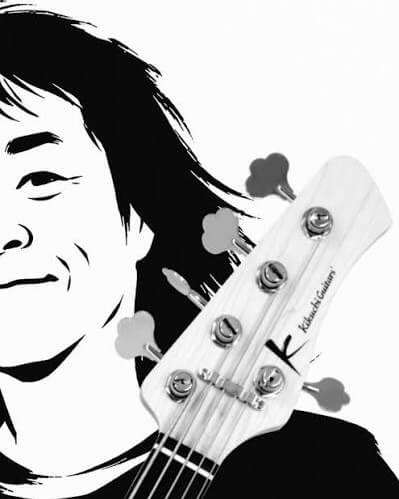
That idea still fits Kikuchi Guitars perfectly. The instrument matters. But ultimately, it exists for the player. More than forty years after Yoshiyuki Kikuchi began putting the pieces of that complicated puzzle together, his own name is on the headstock.
A legacy, made personal.
Yoshiyuki “Yoshi” Kikuchi – A lifetime of Refinement
From his early years as a bass builder in Japan to New York, Roger Sadowsky and John Suhr, and from decades of Japanese instrument building to Kikuchi Guitars — the story of the man whose name finally appeared on the headstock in 2023.
Kikuchi Guitars may be a relatively young name, but the story behind it spans more than four decades of building, repairing, experimenting and learning. It is the story of Yoshiyuki “Yoshi” Kikuchi — a bass player who became a successful builder, then consciously chose to become a student again, and a craftsman who never really stopped learning.
Long before his own name appeared on a headstock, Yoshi had already become part of the Japanese guitar and bass industry. His roots were firmly in bass, and in the late 1980s and early 1990s he became involved in what would become Atelier Z. At the time, his particular fascination was with basses for slap players and with the powerful, articulate character associated with 1970s-style instruments.
But his interest soon went beyond pursuing a particular sound. He became fascinated by the way all the elements of an instrument interact — construction, neck geometry, fretwork, electronics, setup and, ultimately, the hands of the musician playing it.
Years later, Yoshi compared designing and building an instrument to completing a complicated jigsaw puzzle. No single piece creates the whole picture. The satisfaction comes when all the pieces fall into place and the instrument works as a complete entity. For Yoshi, that feeling of accomplishment isn’t just something the builder should experience. The player should feel it too.
A neck that changed his direction
In the early 1990s, a Sadowsky bass came into the workshop with a severely warped neck. Yoshi examined it and eventually concluded that it was beyond repair. With the knowledge and techniques available to him at the time, making a replacement seemed the only realistic solution.
Roger Sadowsky asked Yoshi to send the neck to New York. A few months later, it returned to Japan. Once it was back on the bass and under string tension, the neck was straight. Yoshi was amazed — and, more importantly, curious.
He had already established himself as a professional builder, but instead of simply accepting that someone else possessed a technique he didn’t know, he wanted to understand how it had been done. This was before email became an everyday means of communication, so Yoshi began contacting Roger by fax. What started with questions about a seemingly impossible neck repair gradually developed into an opportunity to learn in person.
Yoshi later explained his decision with characteristic clarity. He was approaching thirty and thought that once he got older, it might become harder to lower his head and ask someone else to teach him. If he was going to do it, he felt, the time was now. So he handed Atelier Z over to a successor, left his family in Japan and travelled alone to New York.
That decision says a great deal about him. He wasn’t a young apprentice taking his first steps into instrument building. He had already built a reputation. Yet he was willing to put himself back in the position of a student because there were things he still wanted to understand.
New York, New York…
Yoshi spent roughly a year working alongside Roger Sadowsky and the experienced craftsmen in the Sadowsky workshop on Broadway. The importance of that year wasn’t simply that Yoshi learned how Sadowsky built instruments. It exposed him to a much broader world of techniques, musicians and approaches to solving problems.
The workshop handled instruments belonging to some of the world’s finest professional players, and Yoshi was trusted to work on them. One job stayed particularly vivid in his memory: working on Will Lee’s vintage Precision Bass while Roger watched over his shoulder.
Other famous musicians and their instruments passed through the workshop too. These experiences were more than colourful memories. They taught him that there is no single perfect solution for every musician. Players have different hands, techniques and preferences, and the instrument ultimately has to work for the person playing it.
During his time in America, Yoshi found another opportunity to learn. He spent several weeks with John Suhr, who was then working with Bob Bradshaw at Custom Audio Electronics and building his early custom guitars. Yoshi assisted him and was introduced to Suhr’s approach to extremely precise fretwork.
The techniques complemented what he had learned at Sadowsky. Roger’s approach gave Yoshi a deep understanding of accurate, consistent setups with excellent intonation and minimal unwanted fret noise. Suhr showed him how fretwork could be taken to another level of precision, allowing exceptionally low string action. Yoshi later joked that Suhr could get the strings so low that you couldn’t fit a price tag between them and the fingerboard.
Behind the joke lies something fundamental to Yoshi’s development as a builder. He wasn’t looking for one “correct” way of doing things. He was collecting knowledge, comparing different approaches and adding techniques to his own repertoire. That philosophy eventually led him to one of his simplest observations about instrument building.
Ask Yoshi today what he considers the most important quality of a great electric guitar or bass, and he still doesn’t choose tonewoods, pickups, electronics or even sound. He chooses playability. If you want a different sound, there are many things you can change: use a pedal, replace the pickups or experiment with a preamp. But, as Yoshi puts it: “You can’t buy playability.”
Playability isn’t a component that can simply be added later. It emerges from the relationship between construction, neck, frets, balance, setup and the musician’s hands. Getting all of those things to work together requires something much harder to buy: experience.
From learning to leading
When Yoshi returned to Japan, his relationship with Roger Sadowsky continued. Working with Okada International, Sadowsky’s Japanese distributor, he became increasingly involved in servicing and developing Sadowsky instruments for Japanese musicians. This eventually evolved into Sadowsky Tokyo and, later, into his leading role in Japanese Sadowsky production.
The relationship had changed considerably by then. Yoshi had originally travelled to New York because he wanted to learn; over the years that followed, he became the person entrusted with translating those standards into a Japanese production environment and building a team capable of maintaining them.
When production of the Sadowsky MetroLine was established in Japan in the early 2000s, it took place under Yoshi’s direction. This presented a very different challenge from building an individual instrument. Making one excellent bass is one thing. Creating a process in which a team of craftsmen can build instrument after instrument to a consistently high standard requires another kind of understanding.
Okada International has estimated that around 10,000 instruments were produced during the Japanese MetroLine era. That scale matters. When you build, inspect, adjust and listen to thousands of instruments, you learn things that cannot be gained from theory alone. You discover which ideas work consistently, where tiny changes make a genuine difference and where they don’t. You learn how to work with specialist factories, how to define standards clearly and how to maintain quality across different stages of production.
Yoshi later described visiting partner factories so frequently that he probably became a nuisance. If a factory was exceptionally good at a particular process, he let them do what they did best. If another part did not meet the required standard, the instrument could be brought back in-house and completed there. The goal was never simply to produce more instruments. It was to produce more instruments without lowering the standard.
The collaboration that had started with a damaged neck and a series of faxes had grown into a relationship spanning decades. By then, Yoshi was no longer simply applying what he had learned in New York. Those lessons had become part of a much larger body of knowledge that was increasingly his own.
Beyond basses: the Sadowsky archtops
Yoshi’s work with Sadowsky was not limited to basses. One of the less widely known chapters of his career is his long involvement with Sadowsky archtop guitars.
Roger Sadowsky had maintained Jim Hall’s D’Aquisto guitar, and when carrying the original instrument became increasingly difficult for Hall, the idea emerged to create a more practical guitar inspired by it. Yoshi was directly involved in bringing that project into production in Japan. Even after the Japanese bass-production agreement with Sadowsky ended, the archtop relationship continued. The Sadowsky archtops sold in New York continued to be produced in Japan, with Yoshi serving as Production Manager. Today, that experience lives on in a complete family of archtop guitars bearing his own name: Kikuchi Guitars.
It shows the breadth of his experience. His career is sometimes described mainly through basses and the MetroLine, but Yoshi’s work also extends deep into jazz guitar and archtop construction — instruments with a very different acoustic character and set of demands.
Finding his own voice
When the long period of Japanese Sadowsky bass production eventually came to an end, Three Dots Guitars became an important next chapter. The instruments were rooted in familiar classic designs but allowed Yoshi to apply his own ideas and methods more freely. In hindsight, it is easy to recognise themes that would later become even more apparent with Kikuchi Guitars.
One is Yoshi’s lack of interest in innovation merely for the sake of appearing innovative. He has never seemed particularly concerned with creating a radically different piece of hardware simply so an instrument can be marketed as unique. When asked whether he has a preference for particular hardware, his answer is essentially no. If something is right for the design, he uses it.
At the same time, he goes remarkably deep into a detail when he believes it matters. Pickups are an example. Yoshi designed pickups himself, experimenting with Alnico magnets, magnetisation levels and windings, repeatedly adjusting them and asking professional musicians to evaluate the results.
Another example is the neck joint. On Kikuchi basses, the neck extends relatively deep into the body and sits in an exceptionally tight-fitting neck pocket. It is a detail most players may never notice at first glance, but one Yoshi considers important to the stability, response and overall feel of the instrument.
It also affects the way the instrument feels in the hands. The deeper neck placement brings the player physically closer to the instrument: a 22-fret bass can feel more like a traditional 20-fret bass, while even a 34-inch scale can have some of the compact, comfortable feel associated with a shorter 33-inch scale — without actually sacrificing the familiar 34-inch scale length.
This is typical of his approach: not necessarily changing what an instrument is, but looking closely at how every part can work better together. This combination — being conservative where change adds little and meticulous where a small improvement can genuinely matter — perhaps explains Yoshi’s approach better than any list of specifications could.
He also speaks about sound in an interesting way. Of course sound matters, but he has never wanted to impose one supposedly ideal tone on the player. Instead, he wants the instrument to respond. The nuances of the right hand should come through. The basic sound should not be overly compressed. The player should be able to express tone and emotion directly rather than fighting against the instrument.
Again, the instrument is a tool for the musician, not the other way around.
The musician behind the builder
There is also another Yoshi behind all the precision, measurements and fretwork. He is still a bass player, and some of his favourite instruments are wonderfully inconsistent with what you might expect from someone who has spent a career pursuing excellent playability.
Among them are a 1977 Gibson Thunderbird and a 1978 Ibanez Flying V Bass. Yoshi freely admits that neither is particularly easy to play. Neither would necessarily be the obvious choice for a builder so focused on playability, but Yoshi wouldn’t part with them. They carry memories of his own years playing in bands.
His musical taste provides another glimpse of the person behind the instruments. Yoshi enjoys many different kinds of music, including heavier rock styles, and has mentioned bands such as Bullet For My Valentine and DragonForce. He doesn’t claim to possess the extreme speed-picking or fast slap techniques some players use, but as a builder he understands what those techniques demand from an instrument.
Fast playing often benefits from low action. Very low action exposes every imperfection in fretwork. And after decades spent studying and refining exactly that, Yoshi has good reason to be confident in the precision of his frets.
The musician and the builder have never really been separate. He may approach an instrument with the eye of a craftsman, but ultimately it has to work in the hands of a player.
Evolution rather than revolution
Seen against this background, the philosophy behind Kikuchi Guitars becomes clear.
Yoshi does not believe in changing things simply to make them look new. Many of the fundamentals of great guitars and basses have proven themselves over decades. His approach is to preserve what works, question what can be improved, and refine the details that shape the connection between player and instrument.
That philosophy can be found throughout Kikuchi Guitars today: in the way the neck joins the body, the feel of the neck profile, the precision of the fretwork, weight and balance, the voicing of the electronics, and the way the instrument vibrates and resonates as a whole. None of these elements needs to be revolutionary on its own. What matters is how they work together.
A fraction of a millimetre in the fretwork, a change in pickup winding, the way vibrating parts interact, or another adjustment inspired by feedback from a musician may seem small in isolation. Over more than four decades, however, those observations and refinements have accumulated into a very personal approach to instrument building.
That is what evolution rather than revolution means at Kikuchi Guitars.
Putting his own name on the headstock
When Kikuchi Guitars was established in 2023, the name was new. The experience behind it was not.
Yoshi’s journey had already taken him from his early years as a bass player and builder through Atelier Z, to New York and the workshops of Roger Sadowsky and John Suhr, and back to Japan, where decades of repair work, Sadowsky production, archtop development and later Three Dots continued to shape his understanding of the instrument. Each stage added something.
Repair work taught him to approach problems from different angles. New York expanded his technical vocabulary. John Suhr introduced him to another level of fretwork precision. The MetroLine years gave him experience in turning craftsmanship into consistent quality across thousands of instruments. His work on Sadowsky archtops deepened his understanding of resonance, acoustic behaviour and jazz-guitar construction. And years of working with professional musicians continually brought the focus back to the same question: how does the instrument feel and respond in the hands of the player?
Kikuchi Guitars brings all of that experience together under Yoshi’s own name. Not as a rejection of what came before, but as the natural next step. Even before the brand was launched, Yoshi spoke about wanting to devote exceptional attention to the vibrating and resonating parts of the instrument in order to create a distinctly Kikuchi playing experience. That idea remains at the heart of the brand today.
There is also a more personal side to his ambition. Asked years ago what he hoped to achieve with his instruments, Yoshi jokingly answered: “World domination.” Then he laughed. What followed was more revealing. He spoke about young musicians around the world who dream of becoming professionals, and about his hope that the instruments he builds might help them on that journey.
That idea still fits Kikuchi Guitars perfectly. The instrument matters. But ultimately, it exists for the player. More than forty years after Yoshiyuki Kikuchi began putting the pieces of that complicated puzzle together, his own name is on the headstock.
A legacy, made personal.